I've been reading about American illustrators recently.
While the Impressionists and post-Impressionists were making headlines in
France (and later in the U.S.), there was something equally exciting going on
here in the States. It was called the Golden
Age of Illustration, although at the time it wasn't called that. Instead it
was a boon for illustrations in books and magazines in order to meet the “new”
mass circulation. The whole concept was brought on because of the advancement
of high-speed presses, cheaper papers and photographic innovations, including
line-engraving and half-tones. And the best news of all was that publishers
were willing to pay more for illustrations.
It’s interesting to note that fine art and illustration were not considered separate entities back then. An illustrator who created for a magazine, such as Winslow Homer for Harper’s Weekly, was considered the same type of artist as an easel artist. It wasn't until the next century in the 20s and 30s that a schism occurred. Illustrators became commercial artists and easel painters were considered the fine art artists. I’ll be covering more on this topic in another post.
It’s interesting to note that fine art and illustration were not considered separate entities back then. An illustrator who created for a magazine, such as Winslow Homer for Harper’s Weekly, was considered the same type of artist as an easel artist. It wasn't until the next century in the 20s and 30s that a schism occurred. Illustrators became commercial artists and easel painters were considered the fine art artists. I’ll be covering more on this topic in another post.
What intrigued me about the artists of the 1850s and onward was how they embraced the camera. Many of them considered it just another tool and many used the new invention here in the States as well as in Europe. Here’s a short list with some examples below:
- Fredric Remington
- Winslow Homer
- N.C. Wyeth
- Toulouse Lautrec
- Edgar Degas
- Vincent Van Gogh
- Paul Cezanne
 |
| Toulouse Lautrec Poster |
 |
| Edgar Degas Dancers |
 |
| Cezanne The Large Bather |
In later years, illustrators would welcome photography as a tool even more with Norman Rockwell leading the way serving as a director in his photo shoots and then tracing the photograph to create his paintings.
Why trace when you
can certainly draw?
I spoke with an illustrator not long ago and posed the same
question. He is an excellent artist who could draw circles around what I do—in his
sleep. So why trace? He said it succinctly, “Time is money.” When you are under
a deadline like so many of these illustrators are, they really don’t have time
or even the money to hire a professional model and spend hours putting down on
canvas what can be translated from a photograph in a matter of minutes.
Rockwell used to hire neighborhood kids, neighbors and friends to pose for him.
What’s more, if you want expression (like a goofy or surprised face) or a
running/walking motion, an artist can’t expect the model to hold the contortion
for an hour or two. It’s difficult. Notice that art before the camera isn’t
quite as action-packed as illustrations or comics are today.
Tracing is the easy
part, finishing the project is harder than you think
Years ago I was in a painting class that everyone projected
their photos onto watercolor paper. I never used it because I was a “purist.”
Okay, I was stuffy. I wanted my paintings to be fresh from my hand, not stilted
from a camera. I continue to believe that if not done properly and with a good
drawing ability, paintings created from tracing do look somewhat off. But that’s
the key—the ability to draw. I can look at a Rockwell painting and even with the knowledge it’s been traced, I’m still awe struck.
Take for instance, The
Perfect Prom Date, listed below. Yes it was all staged by Rockwell, but if
you look closely at the end result, he’s added his own style, more props, more
people and certainly his own color. All his photos were done in black and
white. Moreover the people are not exactly the same in the photo as in the
painting. Rockwell had this incredible talent for drawing the same subject
three or four times and each would look like a different person.

After reading about how these illustrators used photography
to aid them (yes, I've used reference photos for years), I pulled out my handy
Pico projector and decided to do some tracing myself. Fortunately, my Pico is a
hand-held projector so I didn't have too much to do to get the project going. I
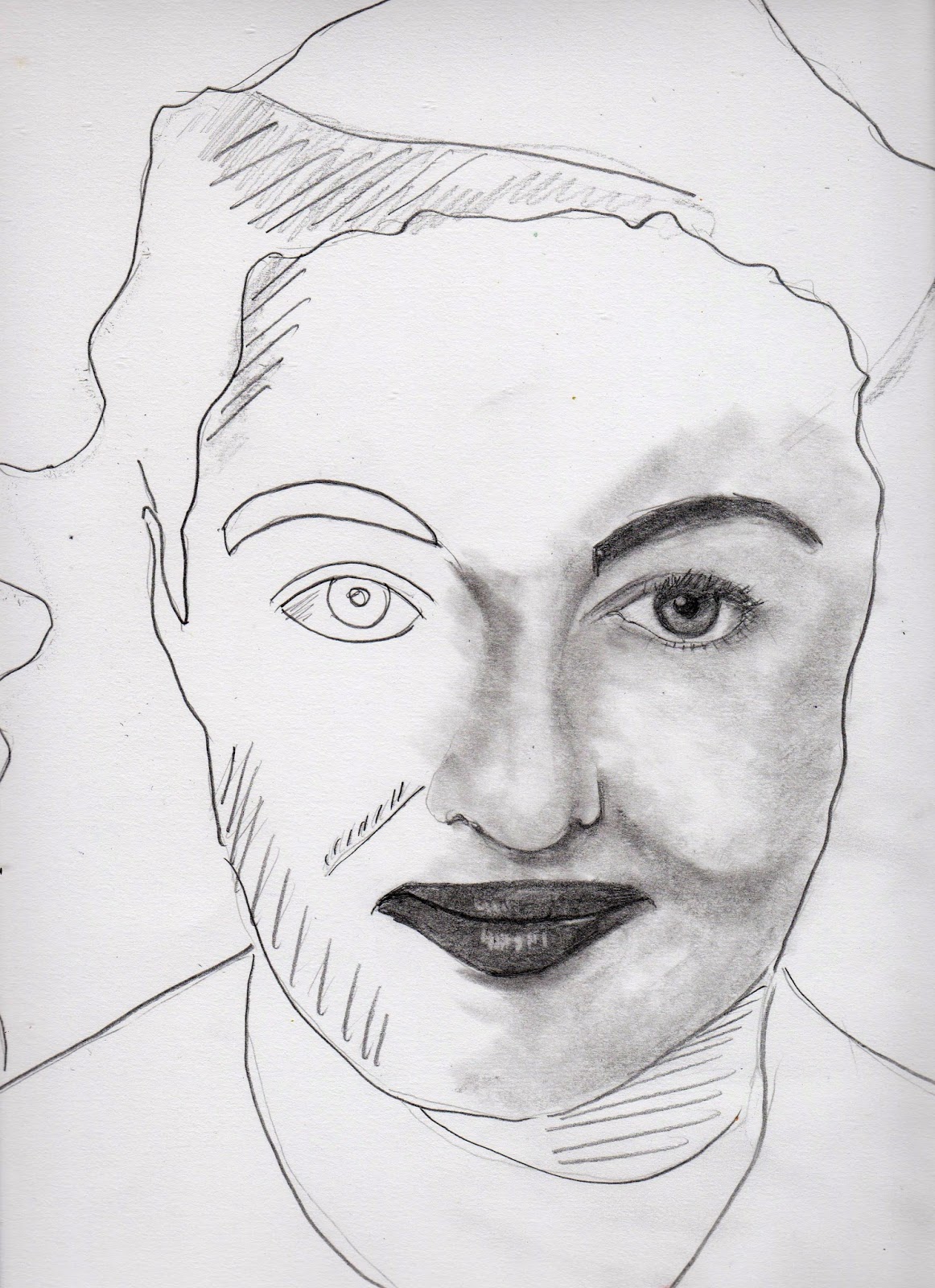
plugged in a photo of Bette Davis and traced it onto some drawing paper. I was
astonished at how hard it was to add the values and all the detail after
tracing. Below is the photo and the drawing. Half of it is the traced side; the
other is the “drawing.” I added the darker lines so that you can see the
outline.
It was harder than I thought and this was just a 15-minute
study. All I really had were the lines, the outline of the face. I had to put
in the rest. As you can see, I still have a long way to go in order to capture Bette
in the drawing. I’m just amazed that Rockwell was able to put color to this as
well.

Tracing can be a
learning tool.
Tracing can be a learning tool as well. In fact, the idea of
using tracing dates back to the 15th century or earlier. A book by
Cennin Cennini, c.1437, entitled The
Craftsman’s Handbook (Il Libro dell’Art) gives instructions on how to learn
about drawing by tracing.
“Chapter XXIII
How you may obtain the essence of a good figure or drawing the tracing
paper.
You should be aware that there is also
a paper known as tracing paper which may be very useful to you. To copy a head,
or a figure, or a half figure, you can find it attractive, by the hand of the
great masters, and to get the outlines right, from paper, panel or wall, which
you want to take right off, put this tracing paper over the figure or drawing,
fastening it nicely at the four corners with a little red or green wax…. Then
take either a pet cut quite fine or a fine brush…and you may process to pick
out with the ink the outlines and accents of the drawing underneath….”
Author and painter Gregory Manchess wrote the article, 10
Things to Remember…About Tracing, where he explores the different
things you can learn by using tracing paper. One point he makes is tracing a
foreshortened object, such a flower or finger. It’s one of the hardest things
to capture in drawing and/or painting. But if you take a piece of vellum and
trace the object, it helps to see the problem. Sometimes we have to do things
to help us really see. Three other points he made that ring true to me:
It helps the memory. About a year ago, I included a video in one of my posts where we saw how John Ruskin used tracing to see how far off he was when drawing a leaf. The same is true for helping you to memorize, such as in anatomy. If I go over the same object many times, I don’t need to trace it anymore. My muscle memory takes over.
It helps the memory. About a year ago, I included a video in one of my posts where we saw how John Ruskin used tracing to see how far off he was when drawing a leaf. The same is true for helping you to memorize, such as in anatomy. If I go over the same object many times, I don’t need to trace it anymore. My muscle memory takes over.
Draw for shape, not detail. As much as I can see with my projector, I found that just including the lines and shapes were much easier and gave me more liberty to finish the drawing in my style—not the camera’s.
Use it as a guide. When tracing Bette above, I again kept my tracing simple, as a guide to help me with the subtle facial positioning.
I know you are probably wondering if I’m smoking something
these days (I’m not). How can I back up tracing? Like I said in the title, it
depends. That is, it depends on the project at hand, is it a commission that
must be perfect, is it a learning possibility, is it a way to see something you
haven’t seen before or is it because you just don’t want to be bothered
learning to draw. Of course, the latter doesn’t help you that much. It’s better
to come to one my classes or workshops to learn how to draw and use tracing to
help you perfect it (okay, I couldn't resist that one itsy-bitsy commercial).
For the next few months I am going to be covering the lives
and art of American artists, beginning with more on Norman Rockwell. It seems
we never spend enough time learning about our own.


